The pack station is rarely the first place a plant manager looks when throughput drops. Attention goes to the conveyor, the line speed, the pick rate. But in many Canadian manufacturing, warehouse, and kitting operations, the bottleneck is exactly there: a worker reaching across an awkward table, waiting for a pre-inflated bag that is not the right size, or pausing production entirely to reload a void-fill machine positioned three metres from where it is actually needed.
This guide is for operations leaders who suspect their protective packaging setup is costing them more than they realise, and who want a clear framework for deciding whether to optimise their current station or integrate a smarter system into the line.
Key question: Is your void-fill process a support function for your line, or is it a constraint on it? The answer determines everything about which solution fits.
The Hidden Cost of a Poorly Positioned Pack Station
Most operations track damage rates and material costs. Fewer track the labour time absorbed by a pack station that was never designed for the current volume or product mix.
Consider what happens when protective packaging is not positioned at the point of need:
Workers walk to retrieve pre-inflated material, adding non-value-added steps to every order cycle.
Cushioning is over-applied because workers grab what is available rather than what the box requires, increasing material spend.
Reloading interrupts flow: a machine positioned away from the station means a worker must leave their post, breaking rhythm and creating micro-stoppages that compound across a shift.
Ergonomic strain accumulates when reaching, twisting, or lifting are built into the packaging step, contributing to fatigue and, over time, injury claims.
What This Looks Like in a Kitting Operation
Kitting operations face a specific version of this problem. Because kitted orders often contain multiple SKUs of varying fragility, the packaging step requires more judgement than a standard fulfilment pick. When the void-fill machine is shared between stations or located centrally, the worker must either over-cushion to compensate for uncertainty or make repeated trips. Neither outcome is efficient.
A line-side machine that produces cushioning on demand, in the right format for the current kit configuration, eliminates both problems. The worker does not leave the station. The cushioning matches the product, not the inventory of pre-made bags.
The cost of inaction is not always visible in a single shift. It accumulates in labour hours, material waste, and damage claims that appear in separate reports and are rarely connected back to the pack station layout.
Two Integration Models: Decentralised vs. Line-Integrated
There is no single correct configuration for protective packaging in a manufacturing or warehouse environment. The right model depends on order volume, product variability, floor space, and how tightly the packaging step is coupled to the rest of the line. Understanding the two primary models makes the decision considerably clearer.
Model 1: Decentralised (Station-Side) Deployment
In a decentralised setup, a compact machine is placed directly at each pack station, producing cushioning on demand as each order is packed. This model suits operations with:
Multiple packing stations handling different product categories
Variable order sizes where pre-made bags are consistently the wrong fit
Floor plans where running a central machine and distributing material is impractical
Kitting workflows where each station has a distinct product mix
The FROMM AP1000 is well suited to this configuration. It weighs 11.5 kg (25.3 lbs), measures 430 x 390 x 360 mm, and operates on standard 100-240V power. A worker can position it at bench height, produce air cushions or bubble-on-demand at up to 20 metres per minute, and adjust the fill rate to match the product in hand, all without leaving the station.
Model 2: Line-Integrated (Automated) Deployment
In a line-integrated setup, the machine is incorporated directly into the packaging line, with cushioning delivered automatically to the station as part of the production sequence. This model suits operations with:
High, consistent order volumes (typically above 300 bundles per day)
Standardised box sizes where cushioning requirements are predictable
Conveyor-based lines where manual steps are already minimised
Distribution centres and 3PL operations where throughput per labour hour is a primary metric
The AP1000 supports semi-automatic and automatic modes and is compatible with FROMM’s integration accessories, including hoppers, winders, and custom-designed conveyor connections. The machine’s patented no-contact end-of-roll sensor prevents production stoppages from undetected film depletion, a common source of unplanned downtime in high-volume lines.
| Factor | Decentralised | Line-Integrated |
|---|---|---|
| Daily volume | Low to medium | High (300+ bundles) |
| Product variability | High | Low to medium |
| Floor space required | Minimal (per station) | Moderate (line footprint) |
| Labour dependency | Low | Very low |
| Setup complexity | Simple | Requires line planning |
| Best fit | Kitting, mixed SKU, multi-station | Distribution, manufacturing, 3PL |
Ergonomics Is an Operational Issue, Not Just a Safety Issue
Canadian operations leaders are increasingly required to document ergonomic risk as part of their health and safety obligations under provincial legislation. But beyond compliance, ergonomics at the pack station has a direct, measurable effect on throughput.
A poorly configured station forces workers to adopt postures that slow them down. Reaching past the optimal work zone to access cushioning material, bending to retrieve bags from floor-level storage, or twisting to feed a machine positioned at the wrong angle: each of these adds seconds to every pack cycle. At 200 orders per shift, those seconds become hours.
Three Ergonomic Improvements That Affect Output Directly
1. Position cushioning at the point of application. The machine should be within the worker’s primary work zone, typically within 30-40 cm of the packing surface, so cushioning is retrieved without a reach or a step.
2. Eliminate pre-inflation inventory. Pre-inflated bags stored in bins require workers to sort through material, select the right size, and manage overflow. On-demand production eliminates the bin entirely. The cushion is made when it is needed, in the size required.
3. Match machine height to the worker and the task. A machine mounted at bench height, rather than floor-standing or shelf-mounted, reduces vertical reach and keeps the worker’s posture neutral through the packaging step.
These adjustments do not require a capital project. In many cases, repositioning an existing machine or switching to a compact, station-mounted unit is sufficient to recover meaningful time per cycle.
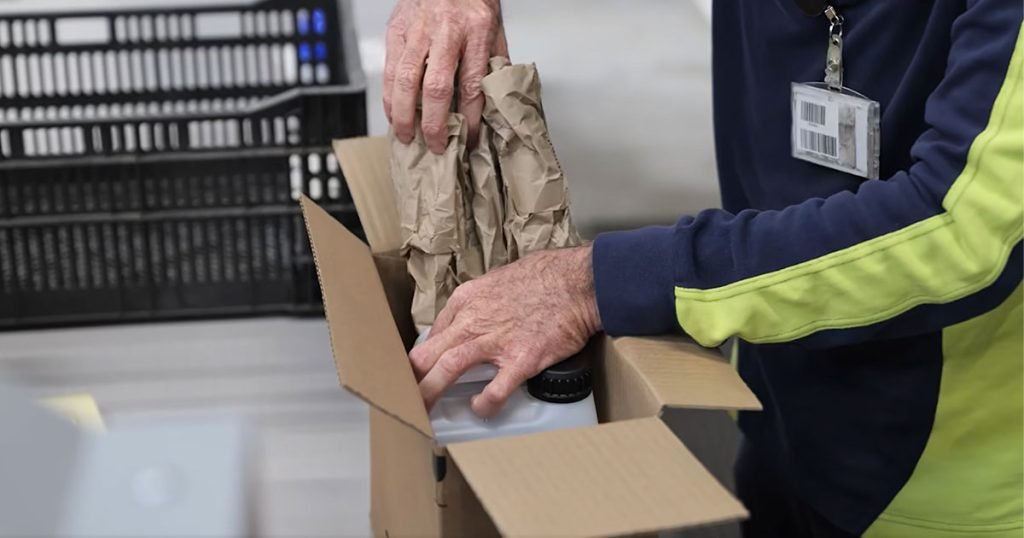
According to research on ergonomic pack station design, operations that align void-fill delivery with the primary work zone report measurable reductions in cycle time and worker fatigue across a shift.
Material Selection: Why the Cushion Type Matters for Canadian Shipments
Not all protective packaging performs equally across the range of products and shipping conditions typical of Canadian operations. Temperature fluctuations, long carrier transit times, and the mix of fragile and heavy goods that characterise manufacturing and kitting shipments all affect which cushioning format is appropriate.
The FROMM AP1000 supports three primary formats from a single machine:
Air cushions (void fill): Lightweight, high-volume protection for filling empty box space. Best for products that are not fragile but need to be immobilised during transit.
Bubble-on-demand: Smaller, denser air cells that provide surface cushioning for fragile or surface-sensitive items. Produced in variable widths up to 800 mm.
Paper-based cushioning: Available via compatible film rolls, this format suits operations with sustainability commitments or customers who require non-plastic protective materials.
A Diagnostic Checklist: Is Your Pack Station Ready for an Upgrade?
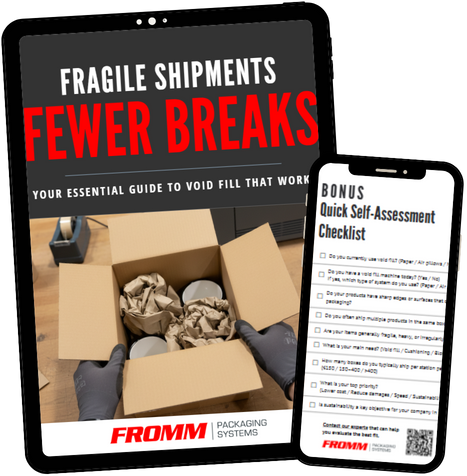
Before committing to a specific integration model, it is worth conducting a brief assessment of the current station. The following checklist identifies the most common indicators that a pack station is constraining throughput rather than supporting it.
Choosing the Right Format for Your Product Mix

For manufacturers shipping hardware, components, or industrial parts, air cushion void fill is typically the most efficient choice: it is fast to produce, lightweight, and does not add meaningful cost to the shipment.
For kitting operations assembling consumer goods, electronics accessories, or mixed-fragility kits, bubble-on-demand provides the surface protection that void fill cannot. The ability to switch formats on the same machine, without a film change or a different unit, is a meaningful operational advantage when the product mix varies by order.
For operations with sustainability reporting requirements, the AP1000’s compatibility with recycled PE (rPE) and biodegradable film provides a documented reduction in virgin plastic use without a change in machine or process.

If three or more of these indicators apply to a current operation, the pack station configuration is likely a measurable constraint on throughput and labour efficiency.
Next Steps
The decision between decentralised and line-integrated deployment does not need to be made in isolation. FROMM Packaging Systems Canada works with manufacturers, warehouse operators, and kitting companies across Canada to assess current station layouts and recommend configurations that fit the actual production environment, including custom integration solutions for operations with non-standard line configurations.
For operations comparing air cushion and paper void fill options, a side-by-side assessment of material cost, output speed, and product suitability is a useful starting point before committing to a machine or consumable format.
Getting Started
A pack station that slows the line is not a minor inconvenience. Across a full shift, across multiple stations, across a year of operations, the compounding effect on labour cost, material spend, and damage rates is substantial. The good news is that the fix is rarely as complex as the problem suggests.
The right machine, positioned correctly, producing the right cushioning format on demand, removes the constraint entirely. The question is not whether to address it; it is which configuration fits the operation.