Electronics packaging is a critical consideration for Canadian warehouses. Electronic products are often high-value, fragile, and particularly vulnerable to damage during handling and transportation. Yet many shipments are still packed in oversized cartons, leaving excess space that allows products to shift in transit.
The outcome is often predictable: damaged shipments, warranty claims, returns, added replacement costs, and frustrated customers. In many cases, the issue is not the product itself, but insufficient or inconsistent protective packaging.
Every electronics shipper faces two distinct threats.
The first is ESD electrostatic discharge, a silent risk that destroys components without leaving a mark. Electronic components like circuit board, sensitive semiconductor devices, sensors and microchips can be damaged by static energy during handling, storage or shipping.
The second is physical impact from drops, vibration, and compression during last-mile transit. Getting either one wrong is expensive. Getting both wrong is a consistent drain on margin and reputation.
This article covers what actually works in protective packaging for electronic devices: the right electronic packaging materials, the right cushioning approach, and the void fill strategies that keep electronics arriving intact. Fromm Airpad offer purpose built protective packaging designed to address the limitations of generic packaging materials in high volume operations.
Why electronics demand a different packaging approach
The invisible damage problem: ESD and why it matters
Electrostatic discharge is exactly what it sounds like: a static charge that moves between two objects when they come into contact or close proximity. The problem is that the threshold for damaging sensitive electronics is far below what a human can feel. A charge you can’t detect can destroy a MOSFET, corrupt flash memory, or degrade a circuit’s operating lifespan without leaving any visible evidence of damage.

ESD damage is particularly costly because it often surfaces as a field failure, not an immediate dead-on-arrival. A component ships fine, passes initial testing, and then fails in the field weeks later. By then, tracing it back to a packaging gap is nearly impossible. That’s why ESD-safe packaging isn’t optional for bare PCBs, IC components, semiconductor assemblies, or any sensitive electronic assembly going into transit.
Physical shock and what actually breaks during transit
Electronics don’t just fail from drops. They fail from sustained vibration on a delivery truck, compression under stacked boxes, and impact at transfer points during sorting. The components most vulnerable to this are solder joints, LCD panels, surface-mounted components, and protruding connectors. These don’t need a dramatic impact to fail. Repetitive low-level shock during a cross-country shipment can be just as damaging.
Most damage happens during last-mile delivery, not in the warehouse. That’s the leg with the most handling, the least controlled environment, and the most variation in how packages are treated. Industry drop and vibration testing, including protocols used by certification bodies like ISTA, consistently shows that packaging engineered for real-world handling conditions reduces transit damage significantly. The packaging has to be built for that reality, not for ideal conditions.
Thermal management and why it belongs in your packaging plan
Temperature swings during transit are a frequently overlooked threat to electronics. Lithium-ion batteries, capacitors, and certain semiconductor packages are sensitive to heat buildup and rapid temperature cycling, both of which occur in unventilated trucks and warehouse staging areas during Canadian summers and winters. While thermal management is often addressed at the product design level, the outer packaging can contribute: insulated liners, thermal bubble film, and proper box sizing all reduce thermal stress during transit. If your product has temperature sensitivity specs, your packaging specification should account for them.
High-value items, high stakes: the cost of getting it wrong
A damaged electronics shipment isn’t just a replacement cost. It’s the return processing, the warranty claim, the customer support time, and the brand trust that erodes when a product arrives broken. For e-commerce electronics sellers, damage rates above two percent start to visibly affect review scores and repeat purchase rates. Proper electronics packaging isn’t overhead. It’s damage-claim prevention, and it pays for itself quickly.
Anti-static materials: your first line of defense
How ESD-safe packaging materials are classified
ESD-safe packaging materials fall into three functional categories.
Conductive materials (surface resistance below roughly 10,000 ohms) allow charge to equalize rapidly and are used for the most sensitive components.
Static dissipative materials (typically 10,000 to 1 billion ohms) allow charge to bleed off slowly and safely, making them the right choice for most board-level electronics.
Anti-static or low-charging materials are designed to prevent charge from building up through friction, but they don’t provide strong discharge control on their own.

Standard bubble wrap and generic foam generate static charge through friction. Placing bare PCBs, IC components, or semiconductor assemblies directly against these materials, while believing you’ve protected them, is one of the most common and costly mistakes in electronics shipping operations.
Cushioning methods for electronics packaging that absorb impact without adding bulk
Foam inserts vs. air cushion film: which does the job better
Pre-cut polyurethane or polyethylene foam inserts offer excellent custom-fit protection for specific product shapes. Polyurethane foam handles small, fragile electronics and vibration well. Polyethylene foam is better for larger, heavier electronics that need structural support. The tradeoff is upfront design time, storage space for pre-made inserts, and higher per-unit cost.
Air cushion film is lightweight, fast to produce on the packing line, and adapts well to irregular shapes. For high-volume electronics packaging in e-commerce where speed matters and product shapes vary, air cushion film consistently wins on cost-per-unit and throughput. The key is using it correctly, not just stuffing it in as an afterthought.
Positioning cushioning around electronics correctly
The standard minimum is two inches of cushioning on all six sides of the box; for more fragile electronics, three inches is the better target. A standard drop test demonstrates that without adequate cushioning depth on each face, peak force transfers directly to the product. Protruding connectors, ports, and antennas need particular attention because they concentrate impact stress at their base. Packaging reliability testing, such as ISTA drop and vibration protocols, confirms that consistent cushioning depth on all faces is the single biggest variable in transit damage outcomes.
Why bubble wrap alone isn’t enough for heavy electronics
Generic bubble wrap is not an adequate sole cushioning material for power supplies, monitors, server components, or any electronics with significant weight. Standard bubble wrap compresses under sustained load and loses its cushioning value before the shipment even arrives. Pair it with structured foam inserts or air cushion pillows for adequate protection, and always confirm that your ESD-safe inner layer is in place first.
Void fill strategies: eliminating movement inside the box
Why empty space is the enemy of electronics in transit
Empty space inside a shipping carton can allow electronic products to shift, vibrate, and make contact with the carton walls or with other items during transit. Over a long shipment, repeated handling, vibration, and minor impacts can contribute to damaged housings, scratched surfaces, bent connectors, or other avoidable issues.
Effective void fill is not simply an aesthetic addition to a package. It helps stabilize the product within the carton, reduces rattling and movement, and supports a more consistent packing process. FROMM’s packaging guidance distinguishes void fill from cushioning: void fill occupies empty space and helps keep products from moving, while cushioning is designed to absorb shock and help protect the product from impact.
For sensitive electronic products, void fill should be selected as part of a complete packaging process that includes the appropriate primary ESD, moisture, and surface-protection materials where required.
Air pillows vs. paper void fill for electronics shipments
Both air cushions and paper void fill can be used to stabilize electronics shipments, but the best choice depends on the product’s weight, fragility, carton size, shipping environment, and packaging requirements.
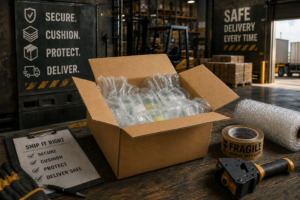
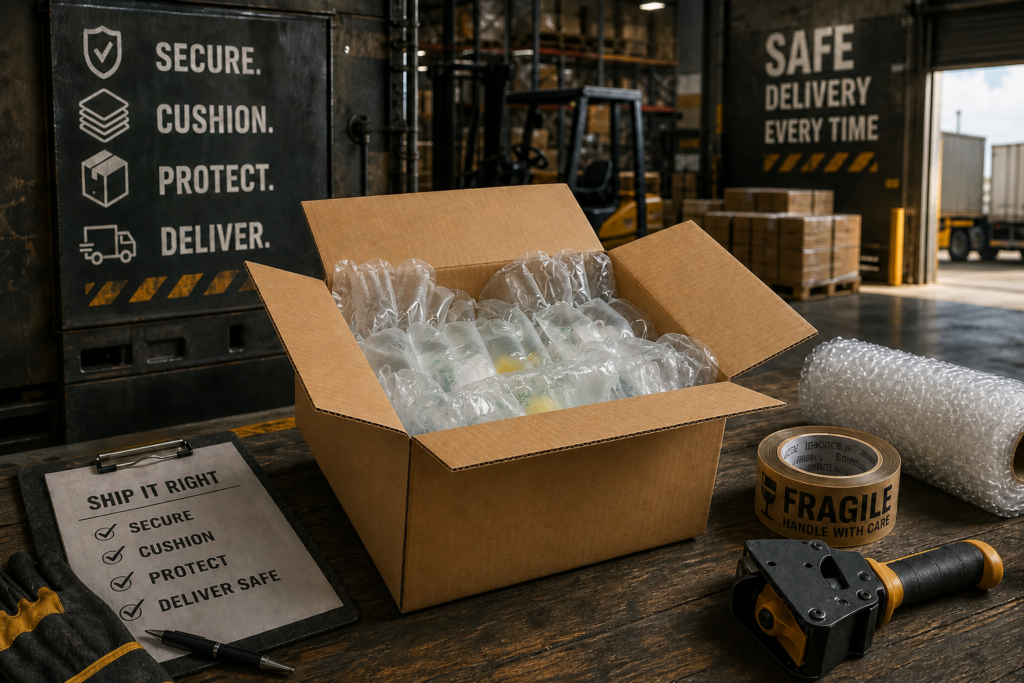
Air cushions are lightweight, on-demand inflated film materials that efficiently fill empty carton space around a product. They can help limit movement while adding minimal shipping weight and requiring little storage space before inflation. This makes them well suited to many parcel-shipping applications, especially for lightweight or moderately fragile electronic products.
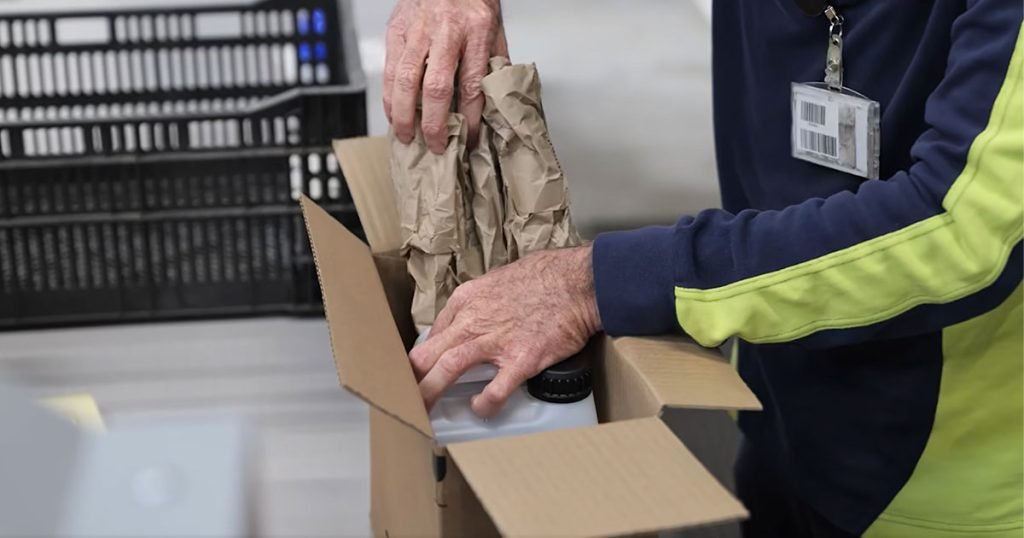
Paper void fill provides a paper-based option for filling gaps, cushioning, and bracing items in a carton. It can be particularly useful where a recyclable paper presentation is preferred or where products require more structured support. However, paper must be applied correctly. Overpacking can place unnecessary pressure on delicate housings, and loosely packed paper may not sufficiently immobilize a product during sustained transit vibration.
Rather than treating one material as universally better, electronics manufacturers should test the packaging method with the actual product, primary ESD packaging, carton, and shipping conditions. The objective is to keep the protected product stable while providing the appropriate level of shock absorption and separation.
Right-sizing boxes to reduce void fill dependency
The most effective void-fill strategy begins with selecting a carton that closely matches the product and its required protective layers. An oversized box creates more unused volume, requires additional void-fill material, and increases the likelihood that the product will move during handling and shipping.
Right-sizing cartons can help manufacturers:
-
Reduce the amount of void-fill material required
-
Limit product movement inside the box
-
Improve packing consistency across shifts and locations
-
Reduce material-handling and storage requirements
-
Lower package size and potential dimensional-weight exposure
-
Create a more efficient, professional unboxing experience
Once the correct carton has been selected, use void fill to occupy remaining open space and keep the product from rattling. Add cushioning where impact protection is needed, and use wrapping where surfaces require protection from scuffing or scratching. For heavier products or a single item requiring firm positioning, blocking and bracing may be the appropriate approach
On-demand air cushion systems: where the AP1000 fits in
Why manual void fill methods don’t scale for electronics shippers
For operations shipping 50 or more electronics orders per shift, pre-cut foam inserts and manual bubble wrap create real operational problems. Storage space for pre-inflated materials, inconsistent packing standards between packers, and the time cost of manual void fill all compound into measurable inefficiency. The inconsistency is the bigger problem: one packer’s version of “adequate void fill” isn’t the same as another’s, and damaged electronics shipments don’t care about good intentions.
What the FROMM AP1000 delivers for electronics packaging operations
The FROMM Airpad Canada AP1000 is a fourth-generation all-in-one air cushion machine that produces four types of protective packaging from a single compact unit: void fill, air cushions, bubble-on-demand, and air pillows. At up to 20 metres per minute, it keeps pace with fast packing lines without creating a bottleneck. The touchscreen control keeps operation simple for any packer, and the IIoT Gateway connectivity lets operations managers track usage in real time and flag maintenance needs before they interrupt the line.
For electronics packing operations, the value is consistency. Every packer on every shift produces the same quality of air cushion packaging, on demand, without relying on stored materials or individual judgment calls. That consistency is what translates to fewer damage claims for high-value electronic shipments.
The material advantage: recyclable film that meets sustainability goals
The AP1000 is compatible with PE film, recycled PE (rPE), and biodegradable film. For Canadian electronics brands and manufacturers carrying ESG commitments or green packaging targets, this means protective packaging for electronic devices doesn’t have to come at the cost of sustainability goals. At 99% air by volume, air cushion packaging uses dramatically less material per shipment compared to foam alternatives, which reduces both waste and the carbon footprint of packaging materials across a full distribution operation.
A practical packing sequence for high-value electronics
The six-step approach from product to sealed box
Common mistakes that undo good packaging choices
Using the wrong box size is the most common starting error. An oversized box undermines everything that follows because it requires more void fill than most operations actually use. Skipping the ESD layer on components that seem “low-risk” compounds the problem, the assumption that something looks sturdy is not a substitute for proper ESD protection. Under-filling the top of the box is equally damaging and just as common. When a box is dropped, the top face often absorbs the first impact, and a thin or empty top void transfers that force directly to the product.
How to evaluate your current electronics packaging process
Pull your last 90 days of damage claims sorted by product category. If electronics represent a disproportionate share of claims relative to their volume, the problem is almost always materials or void fill, not the carrier. Check your current packing spec against the six steps above and identify where the gaps are. Packaging reliability testing standards like ISTA 2A or 3A provide a structured benchmark if you want to validate your spec against real-world conditions. A high electronics damage rate is a solvable problem, and the solution usually starts with getting the inner ESD layer right and the void fill consistent.
The bottom line on electronics packaging
Electronics packaging for shipping isn’t complicated, but it has to be deliberate. ESD-safe materials and two-to-three inches of cushioning on all six sides are non-negotiable. So is controlled void fill that eliminates product movement. The mistake most operations make is treating electronics like general merchandise and being surprised when damage claims pile up.
Consistency is what separates a packaging program that works from one that works most of the time. For operations shipping electronics at any real volume, manual methods introduce variability that shows up in damage rates. On-demand air cushion systems like the FROMM Airpad Canada AP1000 remove the guesswork from air cushion production and give every packer on the line the same reliable output, shift after shift.
If you’re not sure where to start, Book a meeting with FROMM Airpad Canada team directly.
The void fill guide and product finder are practical tools that help you match the right solution to your actual packing volume and product mix, without having to guess.
FAQs on electronics protective packaging
On-demand air cushion systems are the most effective solution for high-volume electronics manufacturers shipping varied SKUs. They provide adjustable cushioning on all six faces of the carton, resist void fill migration during long-haul transport, and add minimal dimensional weight. For extremely fragile or single-SKU applications, custom pre-cut foam inserts provide superior protection.
The total cost of a single damage incident extends well beyond the replacement product. Direct re-fulfilment costs include return freight, replacement product, customer service and warehouse labour, and packaging supplies. When customer lifetime value loss is factored in a portion of customers will not reorder after a damage incident is the true cost per occurrence is substantially higher than most operations teams account for.
The primary causes are shock from drops during LTL handling transfers, cumulative vibration over long-haul routes, and void fill migration that leaves product faces unprotected mid-transit. Canadian shipping conditions amplify these risks due to multi-day cross-country routes and temperature extremes at loading docks in winter.
Yes. FROMM AP air cushion machines are available on a lease or loan basis, which eliminates capital expenditure and is well-suited to operations with seasonal volume variation or those evaluating the system before committing to purchase. Contact FROMM Packaging Systems Canada for equipment and rental options.
Conduct a physical inspection of returned damaged shipments. Look for void fill migration (cushioning concentrated at the bottom of the carton), crush marks on carton exteriors, and product movement inside the sealed carton. A rattle test gently shaking the sealed carton is a simple field check: if the product moves, the packaging has insufficient void fill density.