Automotive Packaging
Transit Damage Is Costing Canadian Automotive Suppliers Millions. Paper Void Fill Fixes It.
How one Canadian operation cut headlamp damage from 5% to under 1%—and reduced packaging time by 55%—with a structured paper cushioning system.
KEY TAKEAWAY
Transit damage on automotive parts is a production problem, not just a shipping problem. When a cracked headlamp arrives at the assembly plant, the cascade includes line downtime, expedited freight, warranty costs, and supplier scorecard penalties. Paper void fill systems reduce damage rates by over 80%, cut material costs by up to 70% compared to foam, and address Canada's tightening EPR regulations—all without requiring a packaging line redesign.
IN THIS GUIDE
The Transit Damage Problem in Canadian Automotive Packaging
DEFINITION
Transit damage in automotive packaging refers to physical harm to automotive parts—cracking, shifting, surface scratching, or deformation—caused by inadequate cushioning between the part and the box wall during shipping. It is one of the most persistent cost drains in automotive manufacturing and directly impacts production line continuity at receiving facilities.
Headlamp assemblies cracked in transit. Sensors shifted loose in under-packed boxes. Windshields that passed final inspection and failed at the receiving dock. These are not edge cases in Canadian automotive packaging. They are the predictable result of a fundamental gap: inconsistent void fill between the part and the corrugated shipper wall.
One of our customers packaging operation documented headlamp damage rates exceeding 5% before redesigning their void fill approach. That rate translated directly into rework costs, replacement part expenses, and disruption at the assembly line. After implementing a structured paper cushioning system, that same operation cut damage to below 1%—and reduced packaging time from 64 seconds to 29 seconds per unit.
The core issue is almost always the same: manual void fill is inconsistent by nature. An operator packing 400 boxes per shift will not apply identical fill volume to every box. That inconsistency drives the variable damage rates that show up in carrier claims data.
How a Canadian Automotive Packaging Line Is Structured
Understanding where void fill fits requires understanding the line itself. Most end-of-line automotive packaging operations in Canada follow a consistent sequence, though the degree of automation varies between tier-1 suppliers and smaller contract manufacturers.
The Typical End-of-Line Sequence
Parts arrive via conveyor from the production or stamping line, typically at high speed and in mixed orientations. Vision systems identify part type, position, and orientation to guide downstream handling. Robotic pick-and-place arms transfer parts into custom dunnage trays, plastic bins, or corrugated shippers—with servo-synchronized conveyors and PLC controllers coordinating timing.
Automated inspection may be integrated at this stage, covering visual and dimensional checks before packing. Void fill is applied at the packing station, either manually or via an inline machine, to cushion parts within the shipper. Packed containers are then palletized, stretch-wrapped, and staged for outbound shipping.
The void fill step sits between inspection and palletizing. In many Canadian operations, it is still performed manually—particularly for odd-shaped or mixed-part scenarios where automation has not yet been justified. This is precisely where damage risk concentrates.
WHY THIS MATTERS
Manual void fill is inconsistent by nature. An operator packing 400 boxes per shift will not apply identical fill volume to every box. That inconsistency is the direct cause of the variable damage rates that show up in carrier claims data—and it is the specific problem that machine-dispensed paper void fill eliminates.
The Real Cost of Transit Damage in Automotive Parts
Transit damage in automotive parts is not just a shipping problem. It is a production problem. When a headlamp assembly arrives cracked at the assembly plant, the impact cascades: line downtime while a replacement is sourced, expedited freight costs, warranty and rework expense, and supplier scorecard penalties that affect future business.
5%→<1%
Headlamp damage rate reduction after paper void fill implementation
55%
Reduction in packaging time per unit (64 sec → 29 sec)
$4.8B
Corrugated automotive packaging market projected for 2026
The financial case is straightforward: at a 5% damage rate on a high-volume part with a unit value of several hundred dollars, the annual damage cost at a single facility can reach seven figures. Reducing that rate to below 1% through better void fill is not packaging optimization—it is a cost recovery project.
Research on corrugated paperboard crumple elements confirms they can dramatically extend the protection range of the cushioning system by lowering shock response spectra and increasing allowable drop heights. This is not theoretical—windshield packaging redesigns that eliminated cracking in drop tests have saved individual Canadian facilities hundreds of thousands of dollars annually.
The corrugated automotive packaging market reflects this urgency, with the segment projected to reach USD 4.8 billion in 2026, growing at a 4.2% CAGR through 2033—driven in large part by the shift toward engineered protective solutions.
A Packaging assessment maps your part portfolio against void fill options and identifies where paper cushioning delivers measurable ROI.
Why Paper Void Fill Outperforms Foam for Most Automotive Parts
DEFINITION
Paper void fill systems convert rolls of kraft paper into crumpled or folded cushioning pads on demand. The cylindrical geometry of these paper structures distributes compressive loads across hexagonal formations, enabling them to withstand high compression stress and replace foam packaging in a wide range of automotive applications.
A 2025 study on kraft paper cylindrical cushioning structures found that the cylindrical geometry distributes compressive loads across hexagonal structures, enabling these systems to withstand high compression stress. Independent analysis shows paper void fill can outperform foam in shock absorption by up to 40%, while delivering material cost savings of up to 70% compared to foam alternatives.
Paper Void Fill vs. Foam Inserts: Head-to-Head Comparison
| Factor | Paper Void Fill | Foam Inserts |
|---|---|---|
| Shock absorption | Up to 40% better than foam | Baseline |
| Material cost | Up to 70% lower | Higher per unit |
| SKU adaptability | Fills any geometry on demand | Requires custom tooling per SKU |
| Warehouse footprint | Compact kraft rolls | Pre-made inserts need significant storage |
| Recyclability | Fully recyclable in paper streams | EPS often landfilled |
| EPR compliance (Canada) | FSC-certified options available | Plastic/foam faces regulatory pressure |
For automotive parts like sensors, headlamps, brake calipers, and ECUs, the adaptability advantage is particularly significant. These parts vary widely in geometry across model years and platforms. Custom-molded foam inserts require tooling investment for each SKU—which becomes cost-prohibitive when managing hundreds of part numbers. Paper void fill machines dispense the right volume for each box regardless of part shape, eliminating that tooling cost entirely.
Machine-Dispensed Paper vs. Manual Application
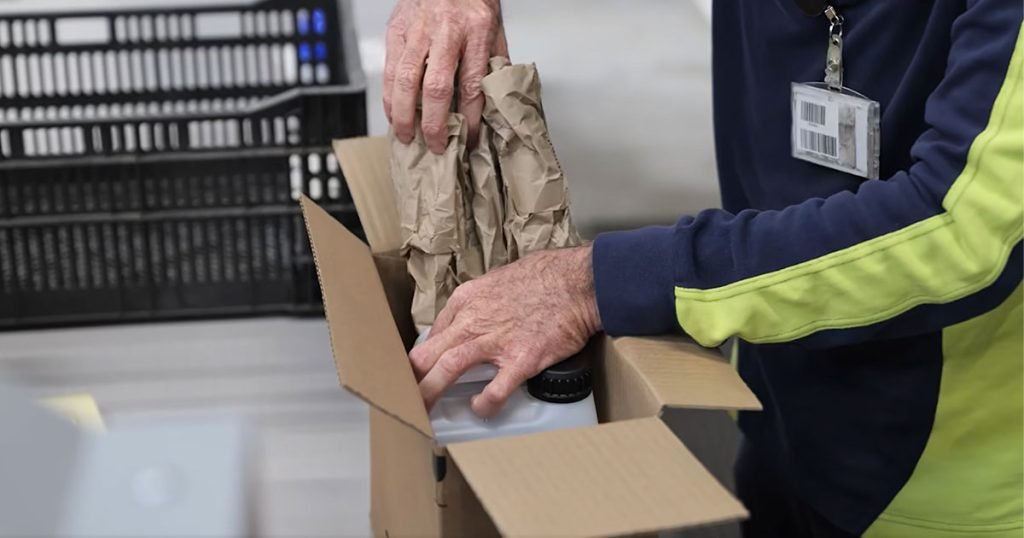
The gap between manual and machine-dispensed void fill is not just about speed—it is about consistency. Systems like the FROMM SmartFill use machine vision to measure the void in each box and dispense precisely the right amount of paper, reducing material consumption by up to 35% compared to manual packing while maintaining protection standards.
The PaperPad PC1000 scales this capability from compact packing stations to high-throughput end-of-line environments, integrating directly into existing packaging lines without requiring a line redesign.

Tight-fit packaging can reduce void fill usage by 50% and boost pallet density by 15%—directly reducing freight costs on cross-border JIT shipments.
How to Integrate Paper Void Fill into an Automotive Packaging Line
Integration is simpler than most engineers expect. A paper void fill machine does not require a line redesign. It occupies the packing station footprint, typically positioned inline after the inspection step and before box closing.
Assess Your Part Portfolio
Map your parts against three criteria: Weight (paper cushioning is optimized for parts up to 15–20 kg), Geometry (irregular shapes with multiple protrusions benefit most—headlamp assemblies, sensors, brake calipers), and Sensitivity (parts sensitive to movement and vibration, including ECUs, navigation modules, and glass components, are high-priority candidates). Parts requiring ESD protection need specialized anti-static paper or supplemental shielding.
Determine Manual vs. Machine-Automated Dispensing
For lines packing fewer than 150–200 boxes per shift, a compact table-top unit like the PaperPad may be sufficient. For higher-volume end-of-line environments, an inline floor unit with SmartFill vision scanning eliminates operator variability entirely. The SmartFill scanner uses AI to measure the empty space in each box and dispenses the precise amount of paper required.
Configure Blocking and Bracing
Paper void fill is most effective when applied using blocking and bracing principles: cushioning positioned to prevent part movement in all three axes, not just vertical drop protection. For sharp-edged parts like stamped brackets or castings, wrap the part in a paper pad before placing it in the box to prevent surface contact damage.
Integrate Box Closing
Systems like the FROMM SmartFill combine void fill dispensing with automatic gummed tape closing, applying water-activated tape with a 10x adhesive bond strength compared to plastic tape. This eliminates a separate taping step and reduces end-of-line labour by consolidating two operations into one.
Validate with Drop Testing
Before full deployment, validate the void fill configuration against ISTA 2A or ASTM D4169 drop test protocols for the relevant distribution environment. A 2025 study on kraft paper cushioning confirmed that properly configured paper systems meet or exceed foam in drop test performance for medium-weight parts—but the geometry and fill density must be validated for each part family.
Over-filling is as problematic as under-filling. Excess paper creates pressure on box seams and can cause blowouts during stacking. Machine-dispensed systems eliminate this risk by controlling fill volume precisely.
Sustainability, EPR, and FSC Certification: The Canadian Regulatory Context
For Canadian automotive suppliers and OEMs, packaging decisions are no longer purely operational. Extended Producer Responsibility (EPR) regulations are reshaping material selection across the supply chain, and the cost of non-compliance is rising.
What Is EPR?
Extended Producer Responsibility (EPR) is a policy framework used in Canada that places responsibility on producers for the end-of-life management of packaging materials. Under EPR, companies that introduce packaging into the market must fund or manage recycling and disposal—creating financial incentives to use recyclable materials like paper over difficult-to-recover materials like EPS foam.
For Canadian automotive suppliers and OEMs, packaging decisions are no longer purely operational. Extended Producer Responsibility (EPR) regulations are reshaping material selection across the supply chain, and the cost of non-compliance is rising.Canada’s EPR framework means EPS foam and plastic bubble wrap—long the default for automotive parts cushioning—face increasing scrutiny because they are difficult to recover and often end up in landfill. FSC-certified kraft paper, by contrast, is fully recyclable in standard paper waste streams and carries chain-of-custody certification confirming the fibre comes from responsibly managed forests.
The Emissions and Cost Case
30%
Reduction in waste and emissions from recyclable, modular packaging
62%
More emissions prevented vs. EPS when switching to optimized paper
36.2%
Global void fill market share held by kraft paper (largest single material)
A 2025 research paper on packaging optimization in the automotive sector found that adopting recyclable and biodegradable packaging, combined with modular systems, can cut waste and emissions by up to 30%. A separate comparative study found that switching to optimized paper-based alternatives can prevent 62% more emissions compared to EPS equivalents.
Paper-based honeycomb transit packaging now holds a 28.6% share of the automotive packaging market, valued at USD 1.2 billion in 2026—reflecting how broadly the industry has already moved toward fibre-based solutions.
OEM sustainability mandates are adding another layer. Tier-1 suppliers increasingly receive packaging specifications from OEMs that require recyclable materials and documented FSC certification. A packaging line running EPS foam or plastic air pillows may face supplier qualification issues as these mandates tighten.
Switching to FSC-certified paper void fill addresses EPR compliance, OEM sustainability mandates, and freight cost reduction (through lower tare weight) in a single material decision. Kraft paper now holds 36.2% of the global void fill packaging market—the largest share of any single material.
FROMM Paperpad for Automotive Packaging
FROMM offers a complete ecosystem of paper void fill, vision scanning, box optimization, and sealing solutions purpose-built for end-of-line automotive packaging environments.
Paper Void Fill
PaperPad PC1000
Compact paper cushioning system with adjustable compression (1.40–2.00 ratio), five production modes, and FSC-certified 100% recycled paper. Integrates with SmartFill Scanner for automated void measurement. Silent operation, bladeless safety design.